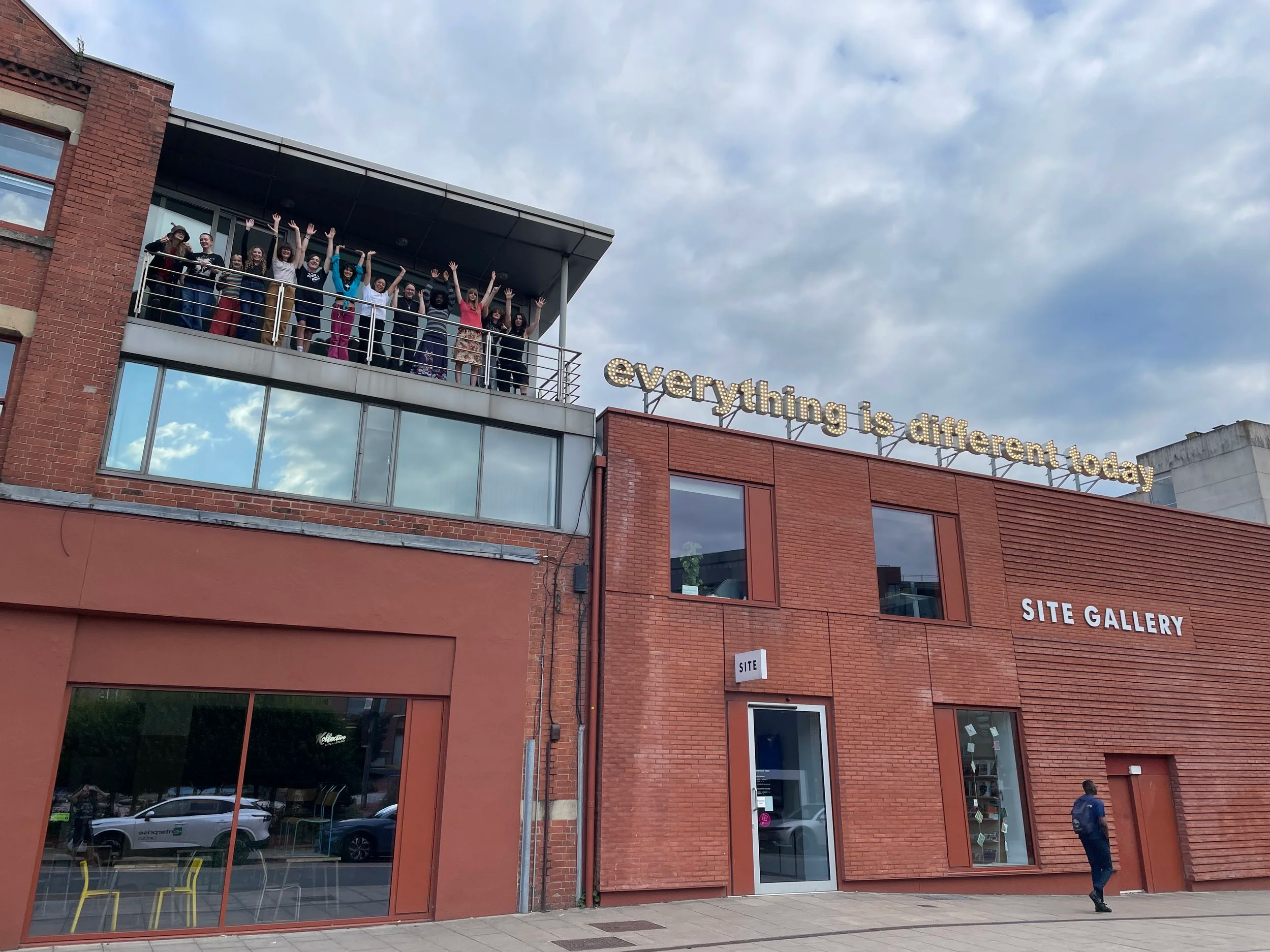
I wrote this just before leaving my part-time role as Participation Producer at Site Gallery this summer. Some thoughts that some might find it of interest or it might stimulate other ideas and ways of working.
The Gentle Route To Lasting Legacy:
Some Thoughts on Embedded Alternative Arts Education Within the Gallery Setting
To be clear, I have spent over 16 years specifically applying for, pitching and setting up, and more often than not failing, to win socially engaged public art commissions, or trying to make the case that a certain pot of money or meanwhile space in a community centre would be best used on an engaged, community-led arts project. It is only in the last two years that I have had the privilege of seeing it from the institutional side proper, in my role as Participation Producer at Site Gallery, Sheffield, where I work alongside the team to realise public workshops that align with the current main gallery show and artists' practice. The predominant amount of my time and my main focus, however, is organising, planning, shaping and running the Society of Explorers: a weekly meet-up group of 14–18 year olds. We run an average of 34–35 sessions a year. We meet every Wednesday during term time, 5–7pm, at the gallery, where we develop our own practices, collaborate with and re-interpret exhibiting artists' practices, road-test workshops with locally based artists, visit exhibitions and artist studios and sometimes go on away days to other cities and galleries. But most importantly, and first things first, we eat.
It does not have to be a three-course dinner, but it certainly needs to be more than a plate of digestives. The single plate of poorly laid-out biscuits signifies a token of the idea of nourishment, and our subconscious is wise to that.
Maslow's hierarchy of needs has always been at the start of me building a space for people to come together and create. In his foundational paper, Maslow articulates the primacy of physiological need:
“He dreams food, he remembers food, he thinks about food, he emotes only about food, he perceives only food and he wants only food.”
(Maslow, 1943, p. 373)
Engagement and consistency come with food. By its nature, it brings people together. It is a shared experience and it nourishes. A nourished body is allowed to relax. Sharing food (breaking bread) creates conversation. Priya Parker argues that sharing food is one of the oldest and most powerful ways humans mark occasions as meaningful, and that intentional gatherings transform ordinary time into something significant. She writes:
“You should, for starters, seek a setting that embodies the reason for convening. When a place embodies an idea, it brings a person's body and whole being into the experience, not only their minds.”
(Parker, 2018, p. 55)
Once the bread is broken and hellos are said, we start to settle and sit. We always begin the session in the same way: in a circle, one person is asked to start, and we go round one by one stating our name, pronouns and what we call a 'one-sentence rant'.
It can be a rant, but it can also be an observation, something funny, or a musing that has been on the mind. No one is forced to do this part, that is made clear at the start. A name is enough.
My colleagues and I have discussed many times whether there is a better word than 'rant' to describe this sentence, and I am sure other practitioners have their own terminology. However, we have always returned to 'rant'. By allowing a venting that often comes from frustration, and 'rant' sums that up well. It is saying: you are welcome to go there. And if you are in fact wanting to share anything toward the more joyful end of the scale, the door has been opened all the way down the corridor toward the angrier end, so all those doors before that, the ones that start with happiness and play, are already open too.
It is always very grounding for everyone to see that we are a constantly changing variety of states, and that others too can be thinking and feeling funny, weird and odd things. It invites us to relax and be comfortable with being ourselves.
Of course, we are not the only people to do a version of this. It is as old as civilisation itself to come together, sit in a circle, introduce oneself and share something. It is still used across all settings and social situations: from business networking, to dating, to drug and alcohol recovery programmes, to Quaker meetings. It works.
These two ways of sharing — the sharing of physical food and the emotional sharing of feeling — are core to humans. The eminent psychologist Carl Rogers addresses this eloquently in his paper 'My Way of Facilitating a Group', in which he describes the depth of mutual recognition that occurs when people meet one another honestly, in a circle. He writes:
“It is the closest I get to an I-thou relationship.”
(Rogers, n.d.)
There is something very powerful in a weekly meet-up group. Something quite unglamorous and steady. It feels quite in contrast to much of contemporary life and to many of the 'hero' projects that flood social media and the press. There is certainly a place for singular, socially engaged projects with a set start date and goal, culminating in a clear piece or body of work that can be packaged up and presented simply and neatly. I understand why these are appealing for journalists, content creators and consumers alike.
The trap, however, is to fall prey to this being the only way, and to be lured in by the number of likes, or second or third-hand public praise for a project. This is made all the harder as so much funding is dependent on and gauged by numbers: the bigger the engagement and visitor numbers, the better. Or so the assumption goes.
Most of us know this not to be true, yet for some reason it is the system within which we often find ourselves working. I could run a project, say, in which each person walking down a high street presses their hand into an ink pad and then against a fifty-metre-long white wall. I could probably have 1,000 'participants' or 'active instances of engagement' in a couple of hours, and a large wall covered in their work. I am not opposed to this, but for me it is not the only way of working. There is no real learning, skills-sharing, community-making or effort to consider, reflect or be challenged. These things take time and need to be done gently and in small groups. This is the argument for weekly meet-ups: consistency, commitment and time for reflection.
We all know this to be true. If we want real, lasting change, it takes effort and structure. You cannot go to the gym once, lift weights for an hour and expect to be fitter or stronger. You have to go regularly, consistently, and gradually build up strength. The rewards will be lasting, but only much further down the line, long after the novelty has worn off and the interest from friends and colleagues has waned, and you are there, still regularly exercising.
So it is with a weekly meet-up group. Having ten to twelve people turning up regularly, to learn, share, play, experiment and challenge themselves critically and creatively is hard work, but the long-term rewards are worth it.
References
Maslow, A. H. (1943). A theory of human motivation. Psychological Review, 50(4), 370–396.
Parker, P. (2018). The art of gathering: How we meet and why it matters. Penguin Books. ISBN 978-0-241-97384-4.
Rogers, C. R. (n.d.). My way of facilitating a group. Centre for Studies of the Person, La Jolla, California. Retrieved from http://www.elementsuk.com/libraryofarticles/myway.pdf